The London Interdisciplinary School – Engaging Complexity – 2024
Introduction
Symbols stand for something else and are agreed upon by convention. They are entities that can arbitrarily refer to other entities in the world. This relationship can be both concrete and abstract, for example the word “car” mapping onto an actual car, or the word “love” mapping onto the more subjective feelings of attraction, attachment and familiarity. Symbols can be studied and organised through the philosophy of signs or the science of semiotics; used in modes of reasoning such as language, logic, mathematics and computation; or externalised into other systems such as cultural artefacts and technologies. In essence, symbolic thought and communication are a fundamental aspect of human action.
Symbols have a deep history, gradually emerging in the early days of our species’ existence and steadily co-evolving with the brain to give rise to the emergence of complex languages and societies. Symbolic systems function by creating representations which mediate between the internal space of individual human minds and the shared space of behaviour and culture. Therefore, they can be used by individuals, communities and cultures in greater or lesser adaptive ways, subject to the perennial selective pressures of entropy, survival and game theory. In order to harness said greater adaptive potential, symbolic systems must orbit around the key behavioural attractors of trust and integrity, or else risk falling into the mush of decoherence and chaos.
In this essay I take a long-view of symbolic culture by tracing its emergence in evolutionary environments, through to its influence on tools for accounting and representing economic value. By doing this I hope to create a solid frame of reference for a review of a more contemporary system, proof-of-work, which emerged in the late 20th century. Proof-of-work was initially designed to prevent email spam, however, early in the 21st century it became the consensus mechanism responsible for securing Bitcoin, a monetary network designed for the information age. By capturing the complexity of both systems, I aim to show how proof-of-work creates a new kind of attractor around which the symbolic representation of value can orbit. Said differently, I claim that proof-of-work brings about a qualitative shift in the space of cultural complexity by directly binding the realm of money to energy, via computation.
The emergence of symbols
The emergence of symbols and the origin of language have much in common, after all, language is a complex symbolic system technically capable of infinite generativity. Its capacity for an endless quantity of novel representations affords the human species an unprecedented inferential toolkit for predicting events, organising memories and planning behaviours. When it comes to the emergent order between these two systems, namely symbolic culture and complex language, there are two schools of thought that dominate the canon. These theoretical frameworks are organised into the continuous and discontinuous, or in other words explanations for a gradual, versus a sudden, emergence of language. Both have shown decent evidence to justify their claims for how such a unique form of communication, seldom found anywhere else in the animal kingdom, came to be. In terms of the discontinuous, Chomsky’s single-step theory is prominent, claiming that a single mutation in our neuroanatomical structure suddenly gave us a universal grammar which enabled us to learn and use complex language. However, for the purpose of my argument, I follow in the footsteps of a more continuous theory, through a reading of Terrence Deacon’s seminal work, The Symbolic Species: The co-evolution of language and the brain.
For Deacon, symbolic communication preceded the emergence of complex language, evolving as a response to a reproductive problem that only symbols could solve: the imperative of representing a social contract. In other words, symbolic communication emerged to fill an evolutionary need for improved social coordination. Deacon’s technical term for this core adaptation is symbolic reference, defined as a unique mode of communication and thought that enables the capacity for abstract words to refer to abstract things. He claims that this process gives rise to our ability to form complex mental networks of relationships between symbols, which need not be grounded in direct experience. Following this line of thinking, symbols must have emerged from more fundamental kinds of natural signs, such as icons and indices, which can be interpreted by living organisms due to their resemblance or causal connection to other things. However, what makes symbols distinct in this respect, is their absence of such properties, despite effectively affording humans coherent representations of, and arbitrary pointers to, entities in the world. Between them, early humans transcended the constraints of similarity and causality by using symbolic thought to create more complex world models (which can be defined as a logical space of reasons conditioned by empirical, modal and normative commitments simulable by an individual mind). As this process increased in emergent complexity, our species gradually moved from prediction to explanation, a powerful shift in cognition that in the spirit of complexity scientist Stuart Kauffman, opened an entirely new adjacent possible of human thought and action. One in which we find ourselves embedded today.
It is precisely this notion of being able to create abstract associations between symbols, other symbols and yet other entities in the environment that leads to the emergence of a complex virtual world, akin to a mind’s eye, that afforded humans more agency and control over nature. Not only did this process enable individual minds to hold more complexity about their environments, but gave rise to more intricate and detailed interaction grammars amongst groups of humans. As this co-evolutionary dance increased in complexity, it was passed down through intergenerational transmission. After much trial and error, it became more closely bound to the reality of an evolutionary environment, be it a hunter-gatherer’s pedagogical account of taking down a meaty woolly mammoth to his budding son, or generally informing one’s tribe of an obscure lion reported nearby. As this mode of communication gradually evolved, shaped by environmental stimuli and reinforcement, a foundational process was put in order for more complex forms of language to emerge. Indeed, Deacon provides ample evidence to demonstrate the gradual change in the brain’s anatomical structure for the accommodation of symbolic reference, showing how our enlarged prefrontal cortex is home to this process of language related symbolic manipulation.
The following scheme demonstrates the core dynamic of symbolic reference in more detail, at once depicting its arbitrary and abstract capacity to form complex mappings between uncorrelated entities. It shows the hierarchical emergence of symbols in the broader context of natural signs, implying icons (top-left) at the bottom of the stack. It shows how indices (top-right) can be learned and transitioned into a closed group of transformations that links different symbols together, giving them their referential power (bottom). Through this scheme depicted below, languages gradually increased in complexity, emerging in communities as cultural objects, outside of, yet shared by individual minds, a process which gave rise to a strong feedback loop of selective pressure on symbolic culture and brain size, forcing both to expand.


As I have attempted to make clear, symbols have their emergent roots at the intersection of biology and early human culture, gradually changing and being changed by a relationship between the brain and behaviour over time. It is at this point we can shift across disciplinary boundaries to focus our analysis on the cultural and economic evolution of symbols, which as they increased in abstraction gave rise to a great deal of adaptive social complexity, however, not without beginning to show their seams.
The symbolic representation of value
As symbolic culture increased in complexity, it gradually gave rise to the social structures and economic practices of early human societies. As this happened, a fundamental shift from representing mere survival-driven behaviours towards the more abstract concept of economic value took place. Consider some of the earliest forms of symbolic representation found in ancient cultures and economies, which include accounting and writing. These acted as adaptive solutions to the environmental and social pressures of growing complexity, some examples of which were the storage of grain surplus, the management of communal labour across temporal distances and the sustaining of growing populations beyond Dunbar’s number. After all, human memory is limited and no individual mind would have been able to keep up with the complexity of even the earliest cities, let alone full blown civilisations. Thus, the externalisation of symbolic thought enabled these early societies to create shared objective maps, whose purpose it was to represent social complexity and inform future behaviour. It did so via encodings of symbolic expressions on physical artefacts that existed concretely outside the minds of individuals. This process enabled a new level of organisational complexity to emerge between individuals, their cultures and the emergent economies they were giving rise to.
Thinking back to the first section, the same co-evolutionary dynamic that turned basic forms of symbolic reference into complex languages appears again in the emergence of the symbolic representation of economic value. By encoding increasingly abstract and arbitrary social agreements around the concept into concrete physical media, ancient cultures started to harness the true power of symbolic representation. Thus, through many loops of recursive abstraction, creative tool-making and an evolutionary imperative to survive, they expanded their social structures and began to form complex economic systems. This emergent process is captured by archaeological evidence for early accounting tools, such as clay tablets used by Sumerians in Mesopotamia, which were used to represent the back-and-forth trade of arbitrary economic tokens, which themselves represented the back-and-forth movement of economic goods such as sheep, grain, and the jars of honey.

As this process evolved, it expanded the scope and complexity of the pursuits within the collective reach of growing civilisations, ultimately giving rise to the emergence of money. Here, money serves as a maximum optionality token that can represent an almost endless amount of different kinds of value, giving it a hyper-normal degree of choice and influence over human action. This unique characteristic of being able to symbolically represent such an unprecedented amount of value transcended the limitations of earlier token systems which were often commodity-specific. By making possible broader trade networks and increasingly dynamic economic interactions, this concept of standardised value brought about by money bridged the gap across different and otherwise disparate cultures, leading to the emergence of a global civilisation of unprecedented complexity and scale. However, this powerful form of symbolic representation didn’t come without emergent constraints, fragility and selective pressures. Take for instance the example of a financial crisis, where the rapid revaluation of assets can outpace the ability of monetary systems to adapt, resulting in severe price crashes capable of destabilising economies and debasing entire cultures. If this isn’t enough, consider the way in which centralization presents another critical vulnerability, where human control over currency becomes concentrated in the hands of a few people, such as a central bank or a dominant market player. History has shown how this pattern forms time and again, increasing the risk for single points of failure or outright manipulation. When this goes wrong, and it has, collapse and a breakdown in trust ensue. This can lead to economic distortions and inefficiencies, breeding the depreciation of value a currency holds via inflation, inequality and discontent.

Symbolic systems such as money are fragile due to their arbitrary and conventional nature. Thus, they are not immune to outright collapse. Historical episodes such as hyperinflation in Weimar Germany or more recently in Zimbabwe showcase how quickly underlying trust in a currency can erode when its symbolic value is decoupled from economic reality. Such collapses can be catastrophic, wiping out savings and collapsing businesses, as a result often leading to widespread social unrest, recession, or even depression. Thus, while the symbolic representation of economic value underpins the historical emergence of complex societies, their adaptive potential is not a given. They require robust safeguards, transparency, and adaptability to maintain their effectiveness and prevent their potential collapse. If they are to prove antifragile in the face of computationally irreducible, which is to say, currently unpredictable aspects of reality, I argue that the symbolic representation of value must keep a strong binding with the external reality it is attempting to represent. If done successfully, it opens up a shared objective space, what we might call a stable attractor, for individual minds to agree upon and coordinate around. In the next section, I will show how proof-of-work achieves this at an unprecedented level, making it perhaps one of the most anti-fragile systems for the symbolic representation of value humanity has ever seen.
What is proof-of-work?
Proof-of-work is the consensus mechanism responsible for securing Bitcoin. It is a process that brings together people, energy and computation in a specific kind of way. In so doing, it creates an immutable distributed ledger and a finite quantity of 21 million tokens (each of which can be divided into 100 million sub-units called ‘satoshis’, therefore meaning there are 2.1 quadrillion overall tokens). It requires people participating in the network, commonly known as miners, to harness energy to run specialised computing hardware, in order to solve a difficult kind of computational puzzle. These miners are financially incentivised by a token reward scheme (an amount which changes over time through a halving event scheduled at regular intervals), which drives a competition of adding new blocks to a chain of existing blocks, hence the popular name blockchain.
Each block is essentially an ordered list of transactions that took place on the network over a period of time and proof-of-work ensures all participants are in consensus that the information in each new block is legitimate and can be permanently added to the ledger, after which it can never be changed. To create a block, miners generate a block header which includes a hash (the output of a hash function of the previous block) linking it to the existing blockchain, the root hash of a Merkle tree (a data structure representing all the transactions they have included in their block), a timestamp and a nonce (mechanisms ensuring chronological order of transactions and sufficient expenditure of computing power to solve the cryptographic puzzle, respectively).
The distinguishing feature in this overall process is a cryptographic puzzle which is difficult to solve, yet easy for the rest of the network to verify. The difficulty of this puzzle lies in finding a nonce (a number that can only be used once in this overall process) capable of producing a hash output that meets a target threshold, set by a difficulty adjusting algorithm contained in the underlying computer program. More specifically, the hash output produced by the miner must be below the target value of the cryptographic puzzle, which changes over time based on how fast previous blocks were successfully added to the network. Miners compete to solve this puzzle by performing computationally intensive work to find a nonce that meets or is below the target threshold. Once they have found a solution, they include it in their block, which they broadcast to the rest of the network. Other full nodes (miners running the full bitcoin program) independently verify the block by checking the transactions and ensuring the hash meets the required conditions. If this all checks out, they accept the block and append it to their version of the blockchain.
In essence, the variable degree of difficulty in solving the cryptographic puzzle means that a certain level of computing power will always be required to compete for the reward, in effect creating a tether between bitcoin and energy, anchored in computational work. In essence, it backs the monetary network of Bitcoin with something that is far deeper in the emergent stack of nature than legacy forms of money. Namely, the capacity to harness physical energy to power and perform computation. Said differently, it depoliticises money by transcending the limitations and regular fallibility of human decision making. Arguably, Satoshi carried out humanity’s biggest leap in abstraction over the concept of economic value since the advent of money itself. Thus, it is here that I want to meditate on considerably, suggesting that this causal connection brings about a qualitative shift in the domain of culture.
To elucidate how and why I think this is the case, I present a conceptual handle developed through analogies across multiple disciplines, including programming, biology and physics, suggesting that proof-of-work creates a binding closure between the symbolic realm of monetary representation and civilisation’s relationship with energy. By analogy, this binding can be compared to the way in which a ribosome creates a proton pump, or a tree harnesses sunlight in a fixed position, or for that matter how the design of a water wheel harnesses the gravitational energy gradient in the flow of a river. These processes all have the characteristically similar trait of tapping into an external energy gradient in a highly predictable and regular fashion. Put definitively, a binding closure is any process which enables a fixed connection across layers of emergence. This is different to an exploratory closure, for example, which instead explores the possibility space within a single layer of emergent potential. A binding closure can be identified in systems that maintain a highly enforceable binding to an external frame of reference or energy gradient over time, in a highly regular and predictable fashion. To deepen the analogy, consider the general process of how a mitochondria performs work by tapping into glucose, an asymmetric, yet ambient chemical energy gradient, converting it into ATP, the primary energy currency of cells. Broadly speaking, this process acts as a binding closure that enables the emergent exploration for a vast number of life forms. It is this level of regularity and predictability between two systems to which I want to attach the concept of binding closures, suggesting that proof-of-work does this between money and energy, in an incorruptible way, hence bringing about a qualitative shift in the domain of culture and the symbolic representation of economic value.
Next, I will offer a quantitative analysis of the proof-of-work mechanism, mathematically showing how it solves two key problems in the design space of money, namely the Byzantine Generals problem and double spend. This quantitative analysis formally demonstrates the low probability of an attacker successfully gaining a majority control over the bitcoin network, which would refute the cultural and economic potential of proof-of-work altogether.
A quantitative analysis demonstrating proof-of-work’s security
To understand the probability of a successful attack on a proof-of-work blockchain such as Bitcoin, we need to consider the scenario of a 51% attack. This is where an attacker, or a colluding group of attackers, gains control of more than 50% of the network’s hashing power(the amount of computing power running the overall network). The mathematics behind the security of proof-of-work focuses on the improbability of such an attacker being able to sustainably alter the blockchain to their advantage, particularly through chain reorganisation. The probability of this happening is as follows. In a 51% attack, the attacker aims to create a private fork of the blockchain, mining their own secret chain which they will eventually publish to replace the main chain. The success of this attack relies on the attacker’s ability to produce blocks at a faster rate than the rest of the network combined, allowing them to create the longest chain which, by the rules of most proof-of-work blockchain protocols, would be considered the valid chain, also known as the longest chain rule. In this scenario, the attacker would be able to perform actions such as double spend, allowing them to spend transactions twice, a fundamental solved by proof-of-work.
Mathematical Formulation
If we assume:
- ‘q’ is the fraction of the total network hash rate that the attacker controls.
- ‘p’ is the fraction controlled by honest miners, so p = 1 – q.
- The probability that the honest miners find the next block is ‘p’, and the probability that the attacker finds the next block is ‘q’.
Given these probabilities, if ‘q > 0.5’, the attacker has a higher probability of extending their chain faster than the honest chain. However, sustaining this over time requires more than just a transient advantage in hash power; it requires maintaining this majority control long enough to build a lead in the blockchain length.
Probability of Catching Up
Let’s consider the attacker is trying to make their private fork the longest chain after being ‘z’ blocks behind the honest chain. The probability ‘P(z)’ that the attacker will ever catch up from ‘z’ blocks behind can be approximated using a result from the theory of random walks, particularly the Gambler’s Ruin problem. The formula for the probability that the attacker will catch up is:
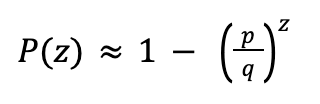
This approximation holds when ‘q > p’ (i.e., the attacker has more than 50% of the total hashing power). If ‘q’ is equal to or less than ‘p’, the probability rapidly approaches zero as ‘z’ increases.
Simplified Example
Assuming the attacker controls 60% of the network (i.e., q = 0.6 and p = 0.4, and they start 0 blocks behind ( a simultaneous start with the honest chain), the probability that they will take over the chain simplifies to:
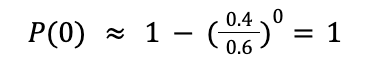
However, if the attacker is starting even a few blocks behind, say 3 blocks, the calculation would be:

This suggests that even a modest disadvantage in terms of blocks can significantly decrease the probability of a successful attack, illustrating why achieving and maintaining a 51% attack is difficult and unlikely, especially when the network is large and well-distributed.
The mathematics behind the security of proof-of-work indicates that as long as the distribution of hashing power is kept decentralised, and no single party approaches or exceeds 50% control, the blockchain remains secure against double-spending via 51% attacks.
Conclusion
Throughout my essay I have made the claim that the power of symbolic culture is a central aspect of human cognition, coordination and culture. It is a process that can be internalised and externalised, abstract or concrete, true or false. It is an emergent phenomena that mediates between the subjective space of individual phenomenology and the objective space of physical reality. It evolved as a cognitive adaptation which enabled early humans to begin representing their shared reality, when harnessed in trustworthy and integral ways, led to a control over nature that completely changed our evolutionary outlook. As this process complexified, it gave rise to the emergence of cultural artefacts that encoded symbolic expression to represent human behaviour and action in recursively abstract ways, leading to the growth of complex economic systems and societies. I tried to apply a key focus to the characteristic trait of symbolic expression to represent reality in ways that are more or less true to how reality actually is. In my research, I found that this was one of the key reasons driving me to see proof-of-work as generating a qualitative shift in culture, in that it creates a binding closure between a key (if not most important) representational system for economic value, namely money, and a highly predictable, out of human control fact of nature (in the same way an isotope doesn’t care about your feelings). To me, this is something quite different to what I found existed in the annals of human civilisations with respect to complex cultural and economic systems. Most, if not all, were subject to the pitfalls of human decision making, game theory and conflict. My essay applied an emergent frame of reference to capture the complexity of these two systems, yet ultimately, I am certain there are more things in heaven and earth than are indeed captured. To conclude, proof-of-work is a 21st century invention that gestures towards a more ordered virtual world and civilisation by attaching the symbolic affordances of money to the objective regularities of energy.
 Henry Vanderspuy
Leave a comment