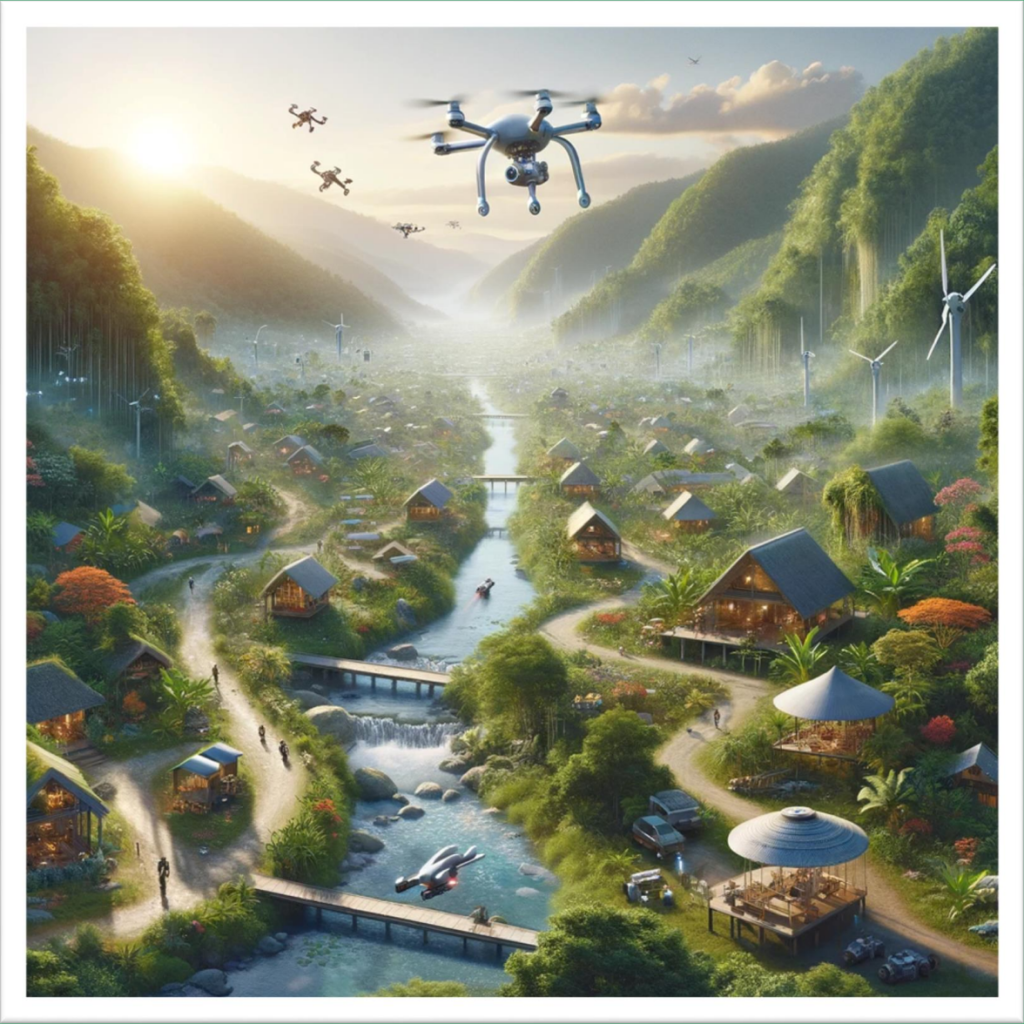
The year is 2094, intelligent machine ecologies are able to construct new homes at groundbreaking speeds. Swarms of drones, humanoids and other novel agents execute the end-to-end synthesis of what are called ‘Houses for Ecologists,’ using advanced materials science pre-centaur humans could’ve only dreamed of. Topological agents, translators of computational irreducibility, bridge the gap between humans and these new forms of intelligence. Together, they form cognitive infrastructures capable of acting on the environment in ways that greatly benefit planetary sapience, both human and non-human. As a result, humanity transformed its wasteful cities made up of concrete and tarmac into a re-wilded civium: a planetary complex of distributed network states coming together to form a mature technosphere. Barefoot walks through civium plazas became the norm. Long-term thinking became widely distributed in cognition, a phenomenon that astrobiologists, the new anthropologists, referred to as ‘Cathedral Mindset.’ And of course, rocket ships took flight, beaming new astrophilosophy and cosmology back to planet Earth, from the Moon and from Mars. Life had become interplanetary.
Amazing to think, that just half a century earlier, humanity had been on the brink of catastrophe, unable to break out of its technological adolescence. Its cities had grown old and overpopulated, unable to seize the latent potential new technologies were offering. Its sense of self was fragmented, jaded by its repeated failure to recognise its own agency, incessantly battling with a planetary process called climate change. In fact, it had gotten so bad, laziness became pervasive, where tremendous feats of ingenuity and discovery such as bootstrapping machines with computational reason, had instead been deployed in highly disembodied and unnatural ways, ignoring a vast and growing ecological crisis where 13 species went extinct each day. It had all seemed impossible, until suddenly it wasn’t. Thankfully, a Copernican turn referred to as the era of ‘endless forms most beautiful 2.0,’ marked the end of the Anthropocene and the beginning of a new human image, a call-to-action, that emerged from its deeply embedded condition of planetarity and the evolution of intelligence.
Around about the 2025 mark, humanity decided to take a leap of faith. Education systems quickly pivoted towards the study and transmission of interdisciplinary methods, augmented by computational media. This new way of learning about the world gave young people a refreshed sense of agency. They began to harness the frictionless and light-speed networks they had grown up with, for new, enlightened purposes, finally breaking out of supernormal traps and networked tribal warfare they had inherited. The immense pedagogical potential held by computational devices was finally put to use in good faith. Spatial modelling and complex simulations enabled teacher and student to see things that the otherwise naked eye couldn’t. Generative worlds began to blend what were traditionally known as disciplines into ephemeral interfaces, collectively navigable devices that explained the emergence and inner similarities of mycology all the way to astronomy. Systems thinking became a basic skill. Byzantine fault-tolerant protocols were at last harnessed by nations and the network state emerged.
Living Models, otherwise known as live-objects, capable of self-evidencing and updating, became the bedrock for new forms of work and production, around which centaur governance structures emerged. These models were encoded with architectures of planetary wellbeing, a fundamental earth-right around which human habitats were built. Their beyond-human capacity to measure and model both chaos and complexity, compelled humans to introduce them as coherence mechanisms for augmented governance and politics. For some time, they quite literally had a seat in parliament. Initially, they were deployed to make existing critical infrastructure such as energy grids, agriculture and transport networks more attuned to the feedback loops and complexity of the biosphere. This led to less waste, less entropy and indeed less chaos. Soon after, symbolic cultures atop these critical infrastructures started to more closely represent the reality from which they emerged, chopping away superfluous post-modern fluff. An age of meta-modernity took hold. Wisdom cultures and ecologies of embodied human practices, such as long-form meditation, cosmo-erotic humanism and cross-cultural ubuntu spread across the globe through these new modes of computationally enhanced pedagogy, science and art. Life itself, from water to wind, whale to woodpecker, became sacred and revered by all of humanity.
— Fin.
The beginning of the 21st century was tumultuous. Powerful modes of explanation and technical artefacts flooded the market, dissolving people’s practices and sense of self. Sensory perceptions were shifted as screens became ubiquitous and targeted directly at the phenomenological experience of everyday people. Planetary scale computation wrapped itself around Earth, offering new modes of explanation and scientific consensus from which to reason about the world and make informed decisions, yet attention was directed elsewhere. Instead, a grueling anthropocentrism plagued cultures, damaging the inhuman in incomprehensible ways. Digital prime, meaning kids who grew up with digital media and screens as their primary form of novelty seeking and extended cognition, became the pedagogical norm, challenging families, parents and teachers alike.
I wrote the above piece, dream on, because I wanted to express a radical feeling towards the contemporary moment. I’m aware that it may come across as what people call, techno-utopian, naive-technocapital optimism, or even accelerationist. However, my intention is for it to be rather a speculative account grounded in my lived experience of the current moment. I was born in 1999. By the age of 25, personal computers had become, by some key measures, 10,000 times more powerful. I sometimes forget that the phone in my pocket is more powerful than the supercomputer used to send men to the moon in the 20th century. This didn’t happen with stone tools, spears or automobiles, thus I try and approach the conditions of the 21st century with epistemic humility, knowing full well my world model might become dissolved at the turn of, say, any particular new year.
Now, whilst this acceleration is quite obviously true, it is nevertheless crucial to take a step back and think about the big picture. Take a moment for example to think about what the world might look like in 10,000 years, if it is even here at all. Who knows. But if we are to speculate, we must engage in a serious bout of creativity and extrapolation, taking epistemologies from the current and projecting them into the flow of deep time. So, in attempting to think about the year 2094, I extrapolated ideas of culture and technology forwards. By looking at the evolutionary speed of machines over the industrial revolution through to the digital age, I speculated that machines are having what I’d venture to call their ‘Simondonian’ moment once and for all, after the French philosopher of technology, who had some pretty interesting perspectives on machines. Indeed, we are reaching a point in the evolution of technology where our encodings of thought, into artefacts, is becoming quite sophisticated. So much so, I recently overhead claims for sparks of sentience… In this essay I extended the notion of robotics (automated labour) coupled with intelligent machinery (cognitive infrastructure) to the year 2094 to depict a world where ecosystems of cognitive agents (humans, non-humans, everything in between) act together to live in harmony on the biosphere. Put bluntly, my prediction is that humanity achieves a mature technosphere by the end of the century, or else they go bust.

 Henry Vanderspuy
Leave a comment