Cosmos, Computation, Coherence
Human cultures tend to create models of the cosmos, mostly in words and images; the Ancient Greeks were first to do so using computational technology. The Antikythera Mechanism, the oldest known analogue computer, was a gear work system for simulating chronological cycles and astronomical phenomena, made in Ancient Greece around or before 60 BCE (Jones, 2023). The artefact was recovered from a shipwreck near the island of Antikythera in 1901 and has since been housed in the National Archaeological Museum of Athens, where it serves as a testament to the level of social coordination present in Ancient Greek culture. At once, the Antikythera Mechanism reveals an application of complex scientific knowledge through complicated mechanical engineering, but perhaps more importantly, speaks to the complexity of social organisation and value systems from which it emerged.
A tall order, the mechanism was an astronomical instrument which acted as a greatly accelerated simulator of the Ancient Greek cosmos (Jones, 2017). Indeed, some 2000 years later, its negentropic success positions it as an astronomical compendium of staggering ambition, capable of computing the ecliptic longitudes of the Moon, Sun and planets, the phase of the Moon; the Age of the Moon; the synodic phases of planets; the excluded days of the Metonic Calendar; eclipses, possibilities, times, characteristics, years and seasons; the heliacal risings and settings of prominent stars and constellations, and last but not least, the Olympiad cycle (Freeth et al., 2021). Its multimodal output made it one of the most sophisticated technologies in Ancient Greece, simulating multiple threads of space and time, providing an interface through which to predict and plan.
The Antikythera Mechanism reflects remarkable craftsmanship, symbolising a skilled cosmotechnics (Hui, 2022) which computationally tethered itself to deep time, bringing forth predictable order to afford human intelligence a coherent place in space. Bound to physical reality in a mechanical fashion, the device offered a deep orientation of thought and action, inspired by and recursively informing an Ancient Greek curiosity for planetary phenomena and cosmology. These complex characteristics of the device reflect principles of Ancient Greek axiological design, a form of design that factors and leverages the intrinsic values inevitably encoded in all technology-human
interfaces (Consilience, 2022), demonstrating their awareness of the mechanism as intrinsically valueladen and value-creating.
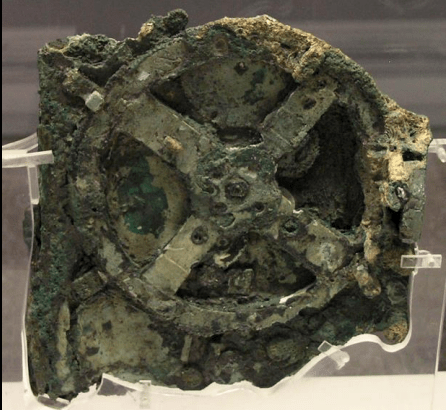
(The largest remaining fragment of the Antikythera Mechanism, Image: Wiki commons)
Modern day reconstructions of the artefact’s mechanical function demonstrate its astro-computational precision, placing it in the historical record as having taken the first steps towards the mechanisation of mathematics and science (Freeth et al., 2021), towards the inevitable space of computational reason. In the words of Stephen Wolfram, ‘despite all the theoretical science that’s been done, the way modern civilization computes the position of the Sun and Moon is conceptually very much like the gears—and effectively epicycles—of the Antikythera device,’ showing just how advanced aspects of its design were.
The Antikythera Mechanism reified Ancient Greek astronomy, bringing forth its intrinsic explanatory power, validating it as a discipline capable of explaining both natural phenomena and social conventions of time-reckoning (Freeth and Jones, 2012). Author of A Portable Cosmos, Alexander Jones, claims that ‘allusions to comparable devices (sphaerae) in ancient literature suggest it was an educational tool, a visual and dynamic counterpart to textbooks of astronomy written for the educated layman.’ By this token, the Antikythera Mechanism was a cultural artefact that directed thought to orient Ancient Greek cognition and enhance social coordination. For example, inscriptions taken from fragments of what remains, have been shown to correlate with the hosting of Olympic games in line with predictable celestial movements (Freeth et al., 2008). After all, the mechanism predicted these events, such as eclipses, decades in advance (Freeth and Jones, 2012). A constructive collaboration between simulation and superstructure, between deep time, calendar time and value systems underscore the epistemic affordances of the astronomical instrument, validating a cultural legacy through its simulation.
This essay proposes that the Antikythera Mechanism was an axiological toolkit that functioned as a coherence mechanism (Pirkowski, 2019), as both an instrumental and epistemological technology, and finally as a sunken but recovered piece of the cultural ratchet. This view of the mechanism places it as both a product of, and foundation for, complex culture and enhanced cooperation in Ancient Greece, but also a treasure of modern archaeology and computation whose axiological design characteristics should be carefully contemplated as we compute forward.
Axiological Mechanism
Technologies encode practices and values into the societies that adopt them, they are values-affecting, not values-neutral. Inspired by Axiology, the philosophical study of value based on ethics and the philosophy of mind, axiological design is the application of principled judgement about value to the design of technology (Consilience, 2022).
Indeed, the Antikythera Mechanism was born out of, or perhaps appeared shortly after the Axial age, depending on which date the mechanism’s creation is taken to be true. The Axial age was an epoch of major psychological change from a period in which short-term orientations dominated, toward a period in which long-term orientations became the cultural norm (Baumard, Hyafil and Boyer, 2015). The mechanism’s low time preference characteristics (Kurz and König, 2022), such as modelling the deep time of the cosmos and predicting eclipses decades in advance, coincide with the shift in cognitive styles commonly associated with the Axial age, including a rise in long-term thinking and self-reflexivity.
Baked into the Antikythera Mechanism are values such as a deep curiosity for astronomy, cosmology and precision, but especially how these epistemologies collaborated to inform and enrich culture, such as the planning of annual events and pedagogy. It’s function as a portable educational tool that embodied complex ideas about the Ancient Greek cosmos and planetary condition, suggest a principled judgement concerning the mechanism’s impact on the kinds of ideas the Ancient Greek’s valued, the quality of attention thus paid to them, and how they affected conceptions of self and world. Not least, it is also a striking illustration of the distinctive role of public science in this civilization (Jones, 2017).
The Antikythera Mechanism’s cosmic simulation came to form a ‘second nature’, a doubling of Ancient Greek cosmology, helping them to better comprehend both their culture, and their planetary condition. The encoding of the Ancient Greek cosmos, primarily represented in natural language and geometry, into the complicated gearwork of the Antikythera Mechanism is a testament to its axiological design. It reflects a complex culture which valued the order of the planets and stars, looking to them for guidance in their social structures and cultural worldview. The mechanism’s scientific simulation externalized and reinforced these values, embedding them within computational technology, thus providing a medium for deep orientation of thought in relation to the Ancient Greek astronomic situation.
The first known computer, the Antikythera Mechanism alludes to the axiological nature of computation, placing it as a technology originating in the pursuit of higher social coordination and more coherent value systems. Its design brought together key ingredients of cosmology and engineering to increase the adaptive behaviour of individuals in Ancient Greek society. A principled judgement of axiological design between astronomy and mechanical engineering weaved together calculation, quantification, and interoperability with orientation, navigation, and cosmology to build an Ancient Greek planetary computer.
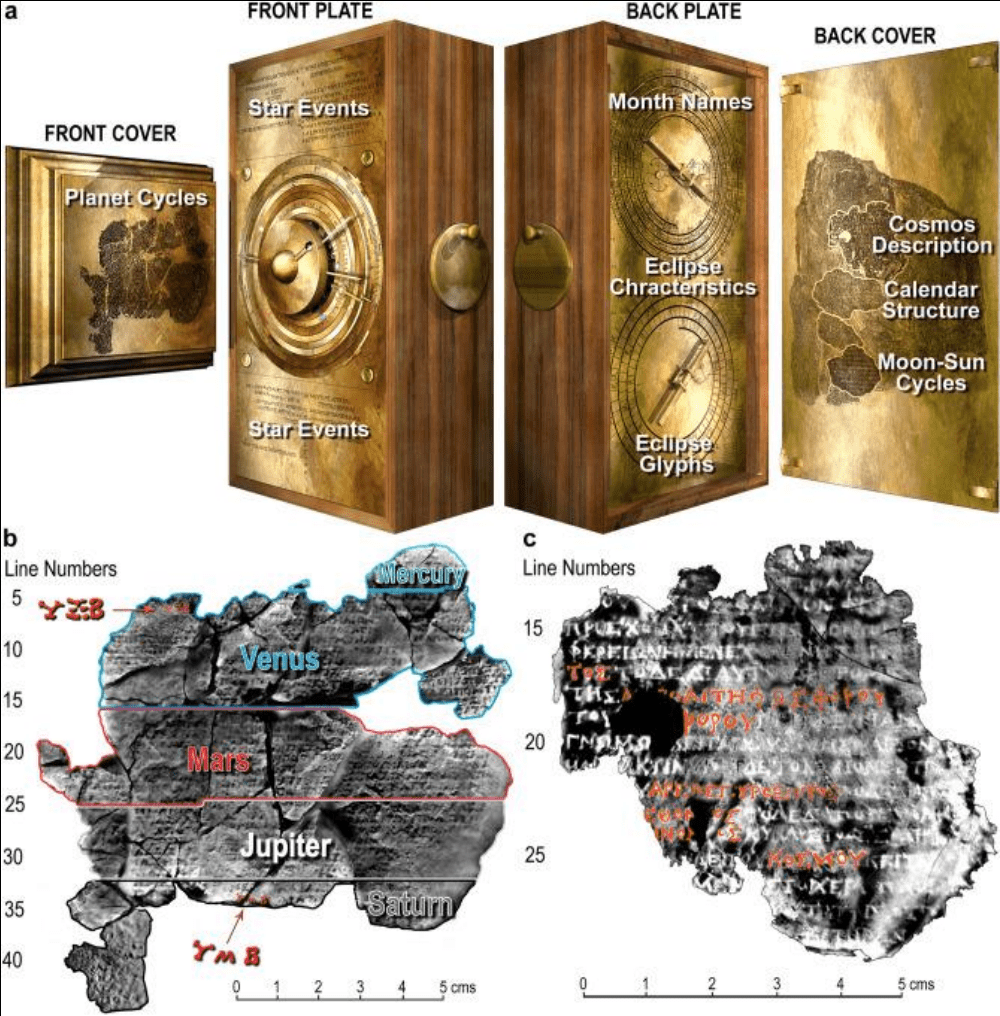
(Freeth et al., 2021)
Ancient Coherence Mechanism
The value of coherence mechanisms (money, language, art) lies in their capacity to coordinate interagent behaviour across time horizons, such that the adaptive needs of individual agents and the emergent collective-as-agent are met (Pirkowski, 2019). The Antikythera Mechanism transcended its role as a mere astronomical calculator to give the Ancient Greeks a coherent foundation for complex culture and cooperation to emerge. Its computational design acted as a coherence mechanism (Pirkowski, 2019) providing a sophisticated toolkit for navigating continuous spaces (AA Cavia, 2022) and for coordinating cultural events based on predictable and regular physical phenomena.
The mechanism functioned as such, by computationally representing the known celestial order, affording a stable attractor for sensemaking, timekeeping and ritual planning. Its intricate gears and precisely calibrated dials formed an external representation of the cyclical nature of the cosmos and provided a guiding framework for understanding the celestial hierarchy, planetary movements, and lunar phases, creating a deeper context window for Ancient Greek cognition, intelligence, and imagination.
The Antikythera Mechanism became a cosmic compass, directing the thoughts and culture of Ancient Greece towards a shared understanding of their planetary condition. Its capacity to simulate and compute a cosmic order, acted as a sensing apparatus between the biosphere, the noosphere, and the cosmosphere (Teilhard de Chardin, 2008), nesting Ancient Greek culture on the surface of a planet embedded within a larger planetary ecosystem. Drawing parallels between this ancient marvel and other more recent coherence mechanisms, such as clockwork and bitcoin, the Antikythera Mechanism demonstrates its core characteristics of being bound to physical reality, embodying regularity, and exhibiting low time preference characteristics.
The mechanical regularity of the Antikythera Mechanism, served as an experiential nexus which descriptively modelled the world and prescriptively oriented Ancient Greek culture. This connection became a focal point, bridging the gap between ancient astronomical understanding and the development of a physical apparatus embodying such knowledge. Its binding to predictable celestial events embedded in and simulated by the mechanism, extended its influence beyond just astronomy to serve as a foundational element that directed the development of other cultural artefacts and thought processes within Ancient Greek society. By aligning cultural activities with the planets and stars, it became a coherence mechanism that bridged the gap between different epistemologies, combining cycles from Babylonian astronomy, mathematics from Plato’s Academy and Ancient Greek astronomical theories (Freeth et al, 2021). The regularity inherent in the device likely facilitated the coordination of communal activities, festivals, and gatherings (Freeth et al., 2008). It became a temporal and chronological guide, enabling the synchronization of diverse cultural events based on a shared objective simulation.
Beyond its immediate applications, the mechanism functioned as a portable educational tool (Jones, 2017), that transmitted and stored ideas about the Ancient Greek cosmos. Its intricate design and functionality made it a tool for conveying complex astronomical concepts across culture. Scholars could use the mechanism as an educational aid, elucidating the principles of celestial mechanics and fostering a shared understanding of the cosmos. It may have also possessed political significance as an impressive and very expensive status symbol that the Ancient Greeks could use to impress (especially a state person) friends, visitors, or other politicians (Moussas, Xenophon 2011).
Through its portability and handy design, it facilitated the transmission of knowledge and ideas related to Ancient Greek cosmology, contributing to a more informed and interconnected society, where the understanding of celestial principles became a shared cultural heritage. Thus, it generated coherence and played a crucial role in shaping the intellectual landscape of Ancient Greece, mechanising the predictions of scientific theories, enabling the transmission of knowledge, and fostering enhanced cooperation around these two key affordances. The device acted as a coherence mechanism amongst its people, increasing their navigational capacity and educational prowess, leading to a deeper and more meaningful complex society. Its simulation of predictable and regular physical phenomena provided a stable attractor for experiential coherence and binding, fostering enhanced cooperation and social coordination amongst the Ancient Greeks. The machine truly served as a cultural model whose influence bootstrapped complicated engineering to form a binding closure for coherent culture.
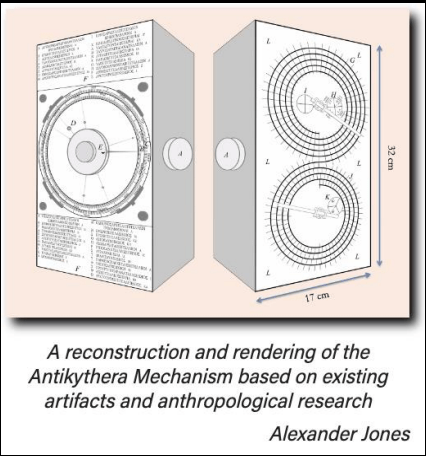
(Alexander Jones, 2017)
The Epistemic affordances of the Astronomical Instrument
The Antikythera Mechanism not only disclosed but also accelerated the planetary condition of intelligence amongst the Ancient Greeks (Bratton, 2022). More than just an instrument for mapping the stars and making predictions, the mechanism functioned as an epistemological technology that revealed and reinforced new processes in the world.
The mechanism expanded the Ancient Greek’s cosmological posture, tethering their cognition to the stars through a portable medium. Thus, it acted as a cognitive infrastructure (Bratton, 2016), which technologically expanded the Ancient Greek cognitive light cone (Levin, 2019) to reveal and reinforce their cosmic order through simulation. These revelations acted as epistemic affordances giving rise to complex forms of coordination, not only through cosmological orientation and navigation, but through the distinct mode of reasoning that the Ancient Greek culture had managed to create: engineered computation.
Through sensing, modeling, and predicting celestial phenomena with unparalleled accuracy, the mechanism disclosed a previously uncharted realm of reality which recursively acted back upon Ancient Greek society in its own image. This led to a more profound comprehension of the cosmos, giving rise to an organisation of intelligence more deeply rooted in its planetary condition, as for example displayed by the upper subsidiary dial following the four-year cycle of the Olympiad and its associated Panhellenic Games (Freeth et al., 2008).
The mechanism’s gears mirrored the intricate dance of planets, offering a dynamic portrayal of the cosmic ballet. This visual manifestation of celestial mechanics not only accelerated the Ancient Greek’s comprehension of planetary motion, but also shaped their intellectual orientation, nurturing a planetary gardening that extended beyond the device itself.
This sense of place enabled individuals to situate themselves within the broader context of the cosmos. The Antikythera Mechanism became a compass, directing the endeavours of Ancient Greek thought, even if that meant just a bringing forth of their intellectual prowess into a tangible medium. Indeed, first-century BC Roman lawyer and consul, Cicero, wrote that Posidonius had made a similar instrument “which at each revolution reproduces the same motions of the Sun, the Moon and the five planets that take place in the heavens every day and night,” and that “…it was actually true that the moon was always as many revolutions behind the sun on the bronze contrivance as would agree with the number of days it was behind it in the sky…” (Marchant, 2006).
By simulating these phases of the planets and their connection to the calendars, the Antikythera Mechanism fortified the scaffolding for a world ordering (cosmology) that extended into and beyond various domains of Ancient Greek society. As an epistemological technology, the mechanism instilled a sense of order and regularity in Ancient Greek cognition.
Its revelations about the cosmos became the cornerstone for a more coherent understanding of reality, influencing thought beyond just the discipline of astronomy. The Antikythera Mechanism, with its intricate representation of planetary motion, acted as a catalyst for the emergence of a sophisticated intellectual and cultural landscape, marking the dawn of a new era in Homo sapiens sapiens’ civilization: Planetary Computation.
In summary, the Antikythera Mechanism, as a computational technology, disclosed and accelerated the planetary condition of intelligence among the Ancient Greeks (Antikythera, 2024), providing epistemic affordances such as orientation, planetarity, and coherence. Its mechanical intricacy and simulation became a foundation for world ordering, reflecting and increasing the complexity that would characterise the rich tapestry of Ancient Greek culture.
Sunken Ratchet
In the words of science fiction luminary Arthur C. Clarke, the Antikythera Mechanism was so sophisticated that, ‘if the insight of the Greeks had matched their ingenuity…we would not merely be puttering around on the Moon, we would have reached the nearer stars’(Jones, 2017). In a similar vein, the great physicist Richard Feynman called it ‘so entirely different and strange that it is nearly impossible” (Jones, 2017). Indeed, a significant gap exists in historical records between the Antikythera Mechanism and the emergence of similar computational technologies. Firstly, no earlier geared mechanism of any sort has ever been found. Secondly, nothing close to its technological sophistication appears again for well over a millennium when astronomical clocks appear in Medieval Europe (Marchant, 2006). Thus, the Antikythera Mechanism both challenges our assumptions about technology transfer through culture and yet gives us new insight into the history of computation.
At the heart of this narrative lies the ratchet effect, a concept illuminated by Michael Tomasello, in which modifications and improvements stay in the population readily with little loss or backward slippage until further changes ratchet things up again’(Tennie, Call and Tomasello, 2009). The disappearance of the Antikythera Mechanism might have put an end to a particular lineage of the cultural ratchet, namely, computational technology acting as a distinct mode of reasoning about the world, an epistemological technology for world ordering. This cultural ratchet built up over time, stretching back to more ancient cultures such as the Babylonians, who painstakingly observed the heavens and with each incremental insight, clicked forward the intellectual wheel (Price, 1967). This wheel of intergenerational transmission reached its zenith with the Ancient Greeks, who ingeniously harnessed and designed computation to implement the astronomical intelligence inherited and refined by their culture. Thus, the Antikythera Mechanism emerges as the culmination of this intellectual journey, a testament to the Ancient Greeks’ capacity to ratchet up their understanding of the cosmos and to open a new space for reasoning about it.
The mechanism transcended the realm of mere calculation, becoming an orientation device, that enabled Ancient Greek intelligence to orient itself in relation to the cosmos. The gears and dials of the mechanism acted not merely as computational elements but as symbolic bridges connecting the intricacies of the celestial with the terrestrial. Standing alone in ancient history, at the intersection of computation, cosmology, coherence, and intelligence; with the shipwreck that sunk the mechanism, so too went down a rich culture of Ancient Greek technē. Hence, a treasure of modern archaeology, the Antikythera Mechanism is a cultural artefact opening new doors of insight into Ancient Greek culture, revealing a primordial relationship with computational technology. From Babylonian stargazers to Ancient Greek craftsmen, the Antikythera Mechanism stands as an eloquent testament to the ratcheting up of astronomical ideas and the axiological implementation of computational technology—a convergence that mechanises cosmology and produces coherence.
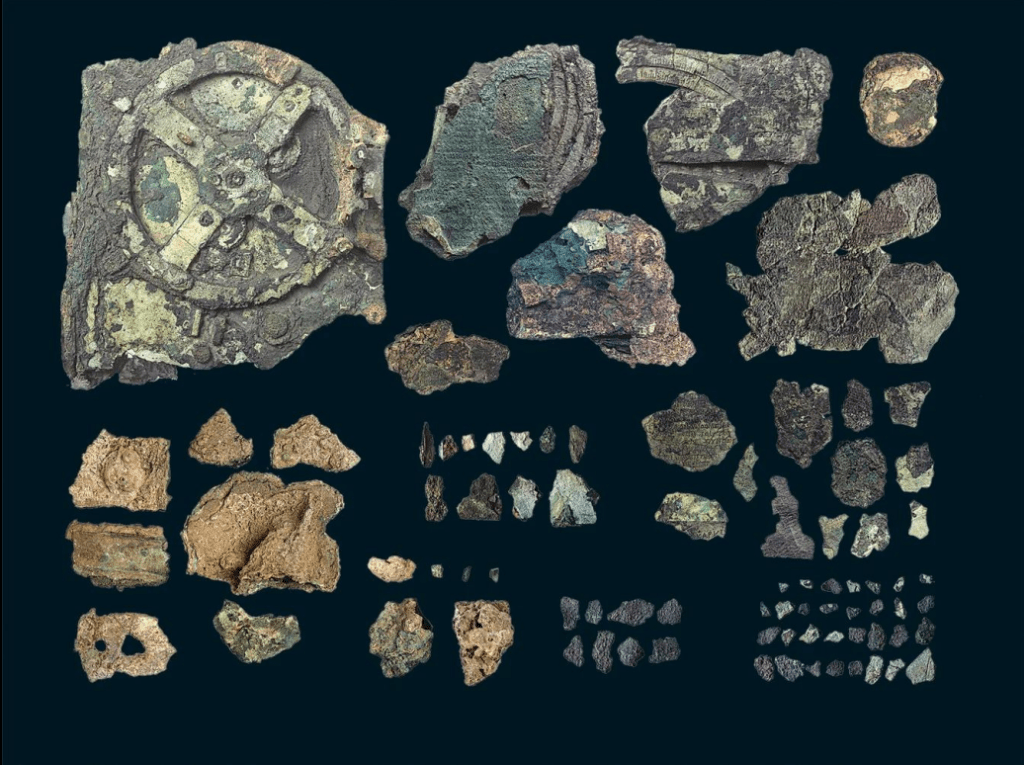
(Fragments, 2005 National Archaeological Museum in Athens)
Conclusion
In the annals of Ancient Greek civilization, the Antikythera Mechanism stands as a high watermark, not just in terms of technological innovation, but as a profound symbol and embodiment for a distinct way of thinking. David Sedley, a classicist at the University of Cambridge says how the machine offered a deeper understanding of cosmic order, with there being “nothing surprising about the fact that their best technology was used for demonstrating the laws of astronomy, it was deep-rooted in their culture.”
As this essay has put forward, the Antikythera Mechanism was a cultural orientation device, developed to augment Ancient Greek intelligence and cooperation. It worked by symbolizing the epistemic accomplishments of Ancient Greek thought. It embodied and built on the adaptive power of collective intelligence to find order and coherence in a world of chaos. This primordial analogue computer transcended its mechanical intricacies to become a testament to the intellectual prowess, cooperative spirit, and social coordination of the Ancient Greeks. It represents an astonishing feat of engineering, showcasing an ecology of complex scientific knowledge and philosophical ideals.
The mechanism was a symbol of a unique mode of thought—a way of thinking through computation about human experience, cooperation, and social coordination. Beyond its gears and dials, the Antikythera Mechanism reflects a sophisticated approach to problem-solving and collaboration. The creation of such complicated technology required not only individual brilliance but also a collaborative effort that brought together astronomers, mathematicians, and philosophers. Its intricate design reflects a collective intelligence, a synergy of minds working in concert to unlock the mysteries of the cosmos. The Antikythera Mechanism unveils a profound philosophical underpinning in the Ancient Greek worldview. By engaging with computational tools, they demonstrated a deep commitment to understanding their place in the cosmos, by looking to the stars and endeavouring to return to their home planet with novel insight. This cosmic dance provided rhythm and reification to Ancient Greek cosmology, serving as a coherence mechanism for social organisation. The Antikythera Mechanism stands as a beacon of Ancient Greek ingenuity, reflecting a society that valued intellectual curiosity, collaboration, and a holistic understanding of the world. It transcends the status of a technological artefact, emerging as a cultural touchstone that encapsulates the spirit of inquiry and cooperation characteristic of Ancient Greece.
For the 21st century, it offers some insight into the nature of what computation might truly be for. Namely, a technology which orients and gives rise to a viable planetarity by amplifying intelligence and fostering coherence. Recovered in 1901, just over a century ago at the time of writing, the Antikythera Mechanism remains a curiosity for ancient history and the philosophy of technology. In a time where exponentially growing planetary computation drives rapid civilisational change, might the Antikythera Mechanism suggest anything about its ultimate purpose? This essay begins to speculate by pointing to some of the learnings we might take hold of when thinking about the Antikythera Mechanism. Namely, it suggests that engineered computation can be composed in ways that enrich, rather than debase the physical substrate upon which it ultimately depends. It suggests that engineered computation can be designed from a first principles of values and ethics, not just physics, which deepens cosmic order and planetarity. It suggests that computational affordances, such as the scientific, but also artistic simulation of reality, can model phenomena which point to lower time preference cultures, longer-term thinking and better sense-making about planetary predicaments. It proposes that the Antikythera Mechanism was more than just an astronomical calculator, going beyond its instrumental affordances to lodge the discovery and invention, the origin, of humanities’ grasp on computation, in a mighty search for cosmic order and social coordination. In the spirit of history rhyming, the Antikythera mechanism continues to inspire cooperation, pointing to alternative directions of agency and design for modern civilization as it continues to restructure its civilization based on a planetary scale computational stack.
Freeth, T., Higgon, D., Dacanalis, A., MacDonald, L., Georgakopoulou, M. and Wojcik, A. (2021). A Model of the Cosmos in the ancient Greek Antikythera Mechanism. Scientific Reports, 11(1). doi:https://doi.org/10.1038/s41598-021-84310-w.
Freeth, T., Bitsakis, Y., Moussas, X., Seiradakis, J., Tselikas, A., Magkou, E., Zafeiropoulou, M., Hadland, R., Bate, D., Ramsey, A., Allen, M., Crawley, A., Hockley, P., Malzbender, T., Gelb, D., Ambrisco, W., Edmunds, M., Edmunds, M., & Uk. (2006). Decoding the Antikythera Mechanism. 444, 587–591. https://www.antikythera-mechanism.gr/system/files/0608_Nature.pdf
Jones, A. (2017). A portable cosmos: revealing the Antikythera Mechanism, scientific wonder of the ancient world. New York, Ny: Oxford University Press.
Baumard, N., Hyafil, A. and Boyer, P. (2015). What changed during the axial age: Cognitive styles or reward systems? Communicative & Integrative Biology, 8(5), p.e1046657. doi:https://doi.org/10.1080/19420889.2015.1046657.
de Solla Price, D. (1974). Gears from the Greeks. The Antikythera Mechanism: A Calendar Computer from ca. 80 B. C. Transactions of the American Philosophical Society, 64(7), p.1. doi:https://doi.org/10.2307/1006146.
planetary-sapience.animaapp.io. (n.d.). https://planetary-sapience.animaapp.io/. [online] Available at: https://planetary-sapience.animaapp.io/ [Accessed 4 Jan. 2024].
Tennie, C., Call, J. and Tomasello, M. (2009). Ratcheting up the ratchet: on the evolution of cumulative culture. Philosophical Transactions of the Royal Society B: Biological Sciences, 364(1528), pp.2405–2415. doi:https://doi.org/10.1098/rstb.2009.0052.
The Ancient Near East Today A PUBLICATION OF FRIENDS OF ASOR. (n.d.). Available at: https://archive.nyu.edu/bitstream/2451/59908/2/Jones%202017%20Antikythera%20ANEToday_Vol5_No10%20(1).pdf [Accessed 3 Jan. 2024].
Pirkowski, M. (2019). Crypto Beyond Capitalism: Part 3. [online] HackerNoon.com. Available at: https://medium.com/hackernoon/crypto-beyond-capitalism-part-3-c6128853ebba [Accessed 3 Jan. 2024].
AA. Cavia (2022). Logiciel.
Kurz, C.F., and König, A.N. (2022). Predicting time preference from social media behavior. Future Generation Computer Systems, 130, pp.155–163. doi:https://doi.org/10.1016/j.future.2021.12.017.
Moussas, Xenophon. (2011). The Antikythera Mechanism. 10.1007/978-94-6091-349-5_8.
Consilience project (2022). Technology is Not Values Neutral: Ending the Reign of Nihilistic Design. [online] The Consilience Project. Available at: https://consilienceproject.org/technology-is-notvalues-neutral-ending-the-reign-of-nihilistic-design-2/.
Bratton, B.H. (2016). The stack: on software and sovereignty. Cambridge, Massachusetts: The Mit Press.
Hui, Y. (2022). Cosmotechnics as Cosmopolitics. [online] Available at: https://editor.e-fluxsystems.com/files/161887_e-flux-journal-cosmotechnics-as-cosmopolitics.pdf [Accessed 9 Jan. 2024].
Marchant, J. (2006). In search of lost time. Nature, 444(7119), pp.534–538. doi:https://doi.org/10.1038/444534a.
Levin, M. (2019). The Computational Boundary of a ‘Self’: Developmental Bioelectricity Drives Multicellularity and Scale-Free Cognition. Frontiers in Psychology, 10. doi:https://doi.org/10.3389/fpsyg.2019.02688.
Price, D. de S. Gears from the Greeks: The Antikythera Mechanism — A Calendar Computer from ca. 80 BC. Trans. Am. Philos. Soc. New Ser. 64, 1-70 (1974); reprinted by Science History Publications, New York (1975).
Jones, A. (2017) A portable cosmos: Revealing the Antikythera mechanism, scientific wonder of the ancient world. New York, NY: Oxford University Press.
Freeth, T. and Jones, A. (2012). The Cosmos in the Antikythera Mechanism. [online] dlib.nyu.edu. Available at: https://dlib.nyu.edu/awdl/isaw/isaw-papers/4/ [Accessed 3 Jan. 2024]
 Henry Vanderspuy
Leave a comment